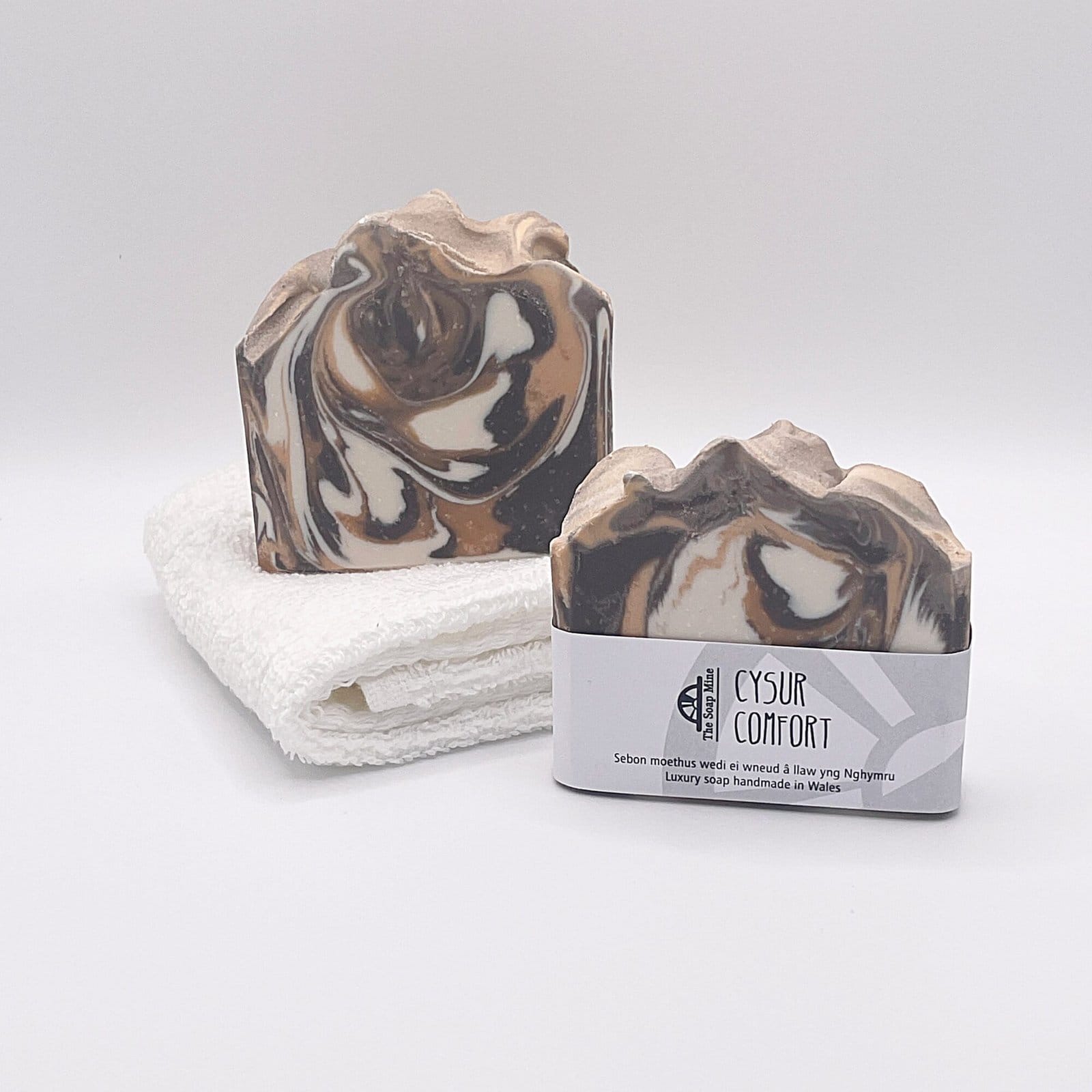
Superfatting. It sounds like something I might accidentally achieve after an enthusiastic weekend of eating cake, doesn’t it? 😂
But in soapmaking, it’s actually a very important part of creating a lovely bar of soap. It’s also one of those things that happens behind the scenes in my workshop that you probably wouldn’t know about unless you’d made soap yourself.
So, what exactly is it?
First, a little chemistry
If you’ve been following Blogtober, you’ll already know that traditional soap is made by combining oils and butters with a solution of sodium hydroxide, otherwise known as lye. The ingredients undergo a chemical reaction called saponification, during which the oils and sodium hydroxide are transformed into soap and glycerine.
The amount of sodium hydroxide needed depends entirely on which oils and butters are used, and in which proportions. This is because different oils require different quantities to turn them into soap. And this is where superfatting comes in.
When I formulate a soap recipe, I deliberately use slightly less sodium hydroxide than would theoretically be needed to turn every last bit of oil into soap. That means a small proportion of the oils and butters remains unsaponified in the finished bar.
This is called the superfat.
For example, if I formulate a recipe with a 5% superfat, I’m using 5% less sodium hydroxide than the calculated amount required for complete saponification. It doesn’t mean that 5% of the finished bar is pure oil, but it does mean I’ve deliberately left some of the oils unconverted.
Why would I want to leave some oil in the soap?
There are two main reasons.
Firstly, it provides a safety margin.
The amounts of sodium hydroxide required to saponify different oils are calculated using something called their saponification values. These values are based on the typical composition of each oil, but natural ingredients aren’t completely identical from batch to batch.
By deliberately using slightly less sodium hydroxide than the theoretical maximum, I allow for some of that natural variation. It means I’m not accidentally going to use too much lye for the oils and butters in the formula. Of course, superfatting isn’t a substitute for accurate weighing, carefully calculated recipes or proper quality control. All of those are still essential.
Secondly, it influences how the finished soap feels.
A bar with a modest amount of unsaponified oils can feel less stripping than a comparable bar without that extra oil. A bar with more sodium hydroxide than is required, even a teeny bit, is going to irritate the skin. Even soap that has EXACTLY the correct amount to saponify 100% of the oils and butters in the formula can feel drying. But the important word here is modest. Because, as with so many things in soapmaking, more isn’t necessarily better.
Can you have too much superfat?
Oh yes. You might think that if a little extra oil is a good thing, adding loads must be even better. Unfortunately, soapmaking doesn’t work like that. Too much unsaponified oil can affect the bar’s hardness, reduce its lather and potentially make it more prone to developing rancidity over time.
So there’s a balance to be found. I want my soap to cleanse effectively, produce a lovely lather, feel pleasant on your skin and last a reasonable amount of time. All of those things have to be considered when I’m developing a formula. And this is why making soap is rather more complicated than simply chucking some lovely oils together and hoping for the best.
Does that mean I can choose which oil stays unsaponified in the soap?
Not really, not with the cold process method I use. If I put olive oil, coconut oil, shea butter and cocoa butter into a batch, I can’t tell the sodium hydroxide to react with everything except the shea butter, for example. The chemical reaction takes place throughout the mixture over a period of 12-48 hrs, so it isn’t possible for the unsaponified portion to be one particular oil or butter.
This is also why claims that a particular expensive oil has been added specifically to remain as the superfat in cold process soap need to be treated with a little caution.
A carefully chosen superfat is an important part of the formulation, and it’s one of the many decisions a soapmaker makes long before the pretty colours, swirls and fragrances enter the picture.
So there you go. Handmade soap isn’t just about how it looks or smells. It’s about understanding the ingredients, knowing how they work together, and finding the right balance to make a bar that’s a pleasure to use.
Vicki x